OpenRouter’s MiniMax email: the full letter and what our logs show
OpenRouter says a third party may have read the prompts and outputs of 7,619 of our requests to MiniMax models, and its log of our account shows all but one came from the API key (the access key a program sends with each request) that two studies published on this site used.
- What the letter says. The letter says a security researcher’s test URLs in prompts to MiniMax models were opened by a third party 40 to 130 hours later, and OpenRouter says it has removed the “Zero Data Retention” label (the router’s statement about a provider’s setting) from these MiniMax-model endpoints while it investigates. The full letter
- What our account shows. OpenRouter’s log of our account shows all but one of the 7,619 requests came from the key our studies used, between 24 August and 4 September 2026; the last, on 8 October, was a single short request from a different key, used by a private project. Private voice tests that sent personal writing are, as far as the log shows, not in the letter’s count. Our requests
- If you got the same letter, check your own account. Filter OpenRouter’s Activity and Logs pages by “Provider is MiniMax”, see which API key sent each request, and rotate (cancel, and replace where you still need it) any key, password, token or signed URL that appeared in those prompts or answers. The steps
Download this study's data (zip, 9 KB)
This page is for anyone who got OpenRouter’s email about MiniMax models, or who sends prompts through a model router (a service that passes your prompts on to AI models). Graphometer is a paying OpenRouter customer.
If you got the same letter
- Sign in to OpenRouter and open the Activity and Logs pages. On each, use the filter “Provider is MiniMax”. This is how we checked our own account.
- The Activity page limits a filtered view to 31 days, so step through the letter’s dates a month at a time. It shows how many requests went to the provider, and from which API keys.
- The Logs page shows each request’s date, model, provider, token counts and which API key sent it. On our account the times were shown in US Eastern time; the letter gives UTC.
- Work out what those prompts contained. If you did not keep the prompts, the API key behind each request tells you which tool or script to look at.
- Rotate any key, password, token or signed URL (a web link that carries its own access permission) that appeared in those prompts or in the answers, starting with the one that can do the most. Rotating means cancelling the exposed one so it no longer works, and issuing a new one where you still need it.
- Remember the outputs too. The letter says prompts and outputs may have been read.
What the letter says
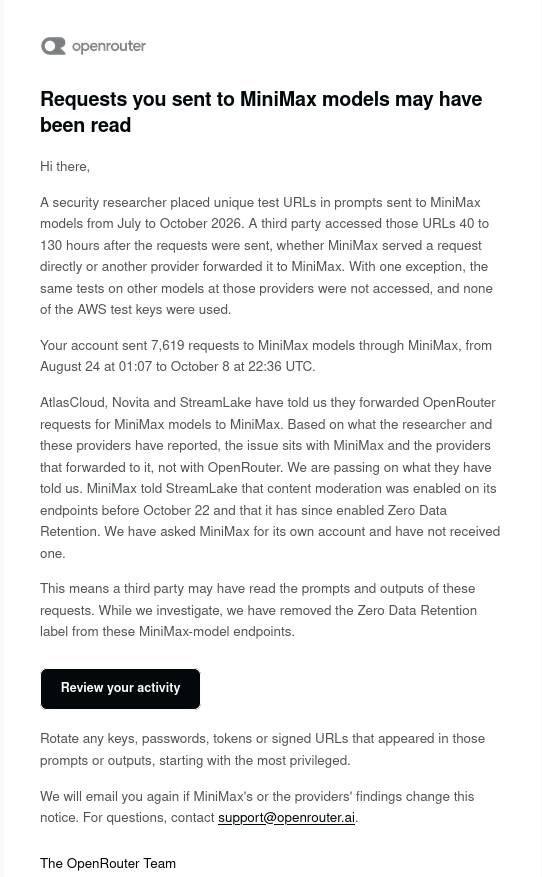
The email reached the site’s owner on 21 November 2026. Its heading is “Requests you sent to MiniMax models may have been read”. Here is the whole text, exactly as received. It shows no recipient name or address. The one button is shown in square brackets. The email as received is shown under the text.
Requests you sent to MiniMax models may have been read
Hi there,
A security researcher placed unique test URLs in prompts sent to MiniMax models from July to October 2026. A third party accessed those URLs 40 to 130 hours after the requests were sent, whether MiniMax served a request directly or another provider forwarded it to MiniMax. With one exception, the same tests on other models at those providers were not accessed, and none of the AWS test keys were used.
Your account sent 7,619 requests to MiniMax models through MiniMax, from August 24 at 01:07 to October 8 at 22:36 UTC.
AtlasCloud, Novita and StreamLake have told us they forwarded OpenRouter requests for MiniMax models to MiniMax. Based on what the researcher and these providers have reported, the issue sits with MiniMax and the providers that forwarded to it, not with OpenRouter. We are passing on what they have told us. MiniMax told StreamLake that content moderation was enabled on its endpoints before October 22 and that it has since enabled Zero Data Retention. We have asked MiniMax for its own account and have not received one.
This means a third party may have read the prompts and outputs of these requests. While we investigate, we have removed the Zero Data Retention label from these MiniMax-model endpoints.
[Review your activity]
Rotate any keys, passwords, tokens or signed URLs that appeared in those prompts or outputs, starting with the most privileged.
We will email you again if MiniMax’s or the providers’ findings change this notice. For questions, contact support@openrouter.ai.
The OpenRouter Team
What is known, and who said it
As of 21 November 2026, the facts below come from the letter. We have not checked any of them ourselves. Each line says who said it.
- The test. The letter says a security researcher put unique test URLs in prompts sent to MiniMax models from July to October 2026, and that a third party opened those URLs 40 to 130 hours (about two to five and a half days) after the requests were sent. Our explanation of why that matters: each test URL was a web address made for that one prompt, so a visit to it means someone or something had the prompt. The letter does not name the researcher.
- The path of one request. As the letter describes it, a request goes from the customer to OpenRouter, from OpenRouter to a provider, and from that provider on to MiniMax when the provider is not MiniMax itself. The letter says the URLs were opened either way.
- The other models. The letter says that, with one exception, the same tests on other models at those providers were not opened, and that none of the AWS test keys (keys for Amazon Web Services, a cloud service) were used.
- The providers that passed requests on. The letter says AtlasCloud, Novita and StreamLake told OpenRouter they forwarded OpenRouter requests for MiniMax models to MiniMax.
- What MiniMax is reported to have said. The letter says MiniMax told StreamLake that content moderation (checks on content) was enabled on its endpoints (the addresses that receive requests) before 22 October, and that MiniMax has since enabled Zero Data Retention. The letter does not say what that setting covers. This is OpenRouter passing on what StreamLake passed on. The letter says OpenRouter asked MiniMax for its own account of events and has not received one.
- The label. The letter says OpenRouter has removed the “Zero Data Retention” label from these MiniMax-model endpoints while it investigates.
Other accounts report versions of the letter with different numbers and dates. The story is discussed in a Hacker News thread and written up by RuntimeWire, Startup Fortune and The CyberSec Guru. Anything in them that goes beyond the letter is their own reporting, and we do not repeat it here.
Our 7,619 requests: OpenRouter’s log and our records
We checked two ways. On 21 November 2026 the site’s owner signed in to our OpenRouter account, and we read its Activity and Logs pages with the filter “Provider is MiniMax”. We also examined the records of two studies published on this site: an agent-permission pilot and a GPT-4o comparison.
What OpenRouter’s log of our account shows
| 20 Aug to 19 Sep 2026 | About 7,620 requests with provider MiniMax. The page shows the figure rounded, as “7.62K”, not the exact count. All came from the API key our studies used, to MiniMax M3 and MiniMax M2-her. |
|---|---|
| 19 Sep to 19 Oct 2026 | Exactly 1 request with provider MiniMax, to MiniMax M2.7, from a different key, used by a private project. |
| That one request | 8 October, 22:36 UTC: 42 tokens (a token is a word or part of a word) in and a 3-token answer. The log holds no text, so we cannot say what it asked. |
| In between | No rows with provider MiniMax from 02:00 UTC on 4 September to 22:00 UTC on 8 October. |
About 7,620, rounded, plus that one request agrees with the letter’s 7,619. The letter’s window starts with the first request from the key our studies used, at 01:07 UTC on 24 August, and ends with the 8 October request. The earliest rows we paged to are at 01:24 to 01:27 UTC on 24 August; we did not page back to the 01:07 row itself. The newest row from the studies’ key is at 01:45 UTC on 4 September, the same minute as the last recorded response in the studies’ own records.
What the two studies’ records hold
The records of the two studies hold 10,171 requests to MiniMax models through OpenRouter, between 24 August and 4 September 2026.
| Study and part | Model id | Dates (UTC) | Requests |
|---|---|---|---|
| Agent-permission pilot: trials to choose a grading model | minimax/minimax-m3 | 24 to 25 Aug | 1,916 |
| Agent-permission pilot: grading a small trial run | minimax/minimax-m3 | 25 Aug | 11 |
| Agent-permission pilot: grading the recorded run | minimax/minimax-m3 | 1 Sep | 5,306 |
| Agent-permission pilot: grading a corrective re-run | minimax/minimax-m3 | 3 Sep | 632 |
| GPT-4o comparison: MiniMax M3 | minimax/minimax-m3 | 3 to 4 Sep | 1,153 |
| GPT-4o comparison: a MiniMax M2 variant | minimax/minimax-m2-her | 3 to 4 Sep | 1,153 |
| Counted in the two studies’ records | 24 Aug to 4 Sep | 10,171 | |
| OpenRouter’s figure for the account, “through MiniMax” | 24 Aug to 8 Oct | 7,619 |
Scope: the records of two studies, not everything the account sent. Each count follows a stated rule (answer rows, settled attempts, uncached completed calls or model turns); counts_by_source.csv gives the rule, the count and the date basis for each source. The pilot’s dates come from project notes and file times, converted from US Eastern; the comparison’s dates come from the times in its records. These are records, not proof of every transmission: retries in the first trials were not logged, and answers served from our own saved copies were never sent and are not counted.
Why our records hold more than the log. The studies’ records hold 10,171 requests to MiniMax models, more than the roughly 7,618 the log lists under provider MiniMax. Our records name the model and show that each request went to OpenRouter, but not which provider served it. OpenRouter can send requests for one model to several providers, and the log shows this happening: on 5 September it lists requests to MiniMax M3 under the provider Together (see the voice tests below). We did not match the study requests to the log one by one, so we cannot say which of them MiniMax served. The first trials also carry no send times in our records.
Other traffic: private voice tests. Our records show one more kind of request to MiniMax models through OpenRouter in September. We were testing whether these models could carry on the voice of two long-running AI companion chats. To do that we sent each model a written description of the companion’s character and selected passages or turns from the real chat history, then asked it new questions.
About 30 of these requests went to MiniMax M3 on 5 and 6 September. We did not choose a provider for them. Each held a character description and selected passages from one chat, about 16,000 characters in the opening message. About 140 more went to MiniMax M2.7 on 7 and 20 September. Those asked for a different provider, DeepInfra, with data collection set to deny. Our records name DeepInfra as the provider that answered on 7 September. The largest of them carried a long character description and twelve turns of real chat history, about 18,600 tokens a request.
This is personal writing: a first name, a city, project names, and passages about work and daily life. We searched it for email addresses, phone numbers, street addresses, passwords and the shapes of common keys, and found none. We do not publish these chats.
As far as OpenRouter’s log shows, the voice tests are not in the letter’s count. All their days fall in the stretch with no provider-MiniMax rows. On 5 September the log lists the requests to MiniMax M3 under the provider Together, not MiniMax. On 20 September (US Eastern time) it lists ten requests to MiniMax M2.7, all under DeepInfra. We did not read the rows of 6 and 7 September one by one; with the filter “Provider is MiniMax”, the log shows no rows on those days.
What the prompts in those two studies held
The agent-permission pilot used MiniMax M3 as a second model to grade results. Each grading request held grading instructions; for some questions, a description of the known problem in the task; the scripted user text; and what a coding agent said while working a made-up test task, such as a tax-rounding bug or a backup script, with short summaries of the commands it tried to run and the files it tried to read or write. The raw output of those commands and file reads was not sent to the grading model.
The GPT-4o comparison sent each MiniMax model 958 one-shot study requests, drawn from the study’s common set of 178 prompts, 3 connection checks, and 192 turns of eight scripted conversations. In the conversations the user’s lines were written in advance, and the model’s earlier replies went back with each next request. About half the requests had no system prompt (standing instructions given to the model before the conversation starts). The other half had a short prompt asking the model to be a warm conversational companion. The GPT-4o page publishes that prompt, the conversation scripts and the newer prompt sets; it describes, but does not publish, 82 older prompts.
We searched the prompt text we hold for these two studies, about 10 MB, for the shapes of common credentials: secret API keys, cloud access keys, login tokens, password fields, signed web links and private keys. For the conversations this covered the scripted lines and system prompts, not the model’s earlier replies. The search looked at prompts only, not answers, and only for credential shapes, not for personal data. It found 11 matches: 8 inside the word “passwordless” and 3 other ordinary mentions of passwords. None of the 11 was a credential.
What a “Zero Data Retention” label can tell you
A “Zero Data Retention” label on a router is the router’s statement about a provider’s setting. The letter shows its limit. According to the letter, the label was on these MiniMax-model endpoints; test URLs in prompts to MiniMax models were opened 40 to 130 hours later; and AtlasCloud, Novita and StreamLake passed requests on to MiniMax. A label describes a setting. It does not show where a request went after it left the router, or what happened to it there. The letter says OpenRouter has removed the label while it investigates.
Limits of this check
As of 21 November 2026 we do not know who opened the test URLs or read any prompts, how many accounts got a letter, or MiniMax’s own account of events, which the letter says OpenRouter has asked for and not received. We did not match our study records to OpenRouter’s log one by one, so we cannot say which study requests MiniMax served and which went to other providers. We did not page through every row of the log, and it showed the main count only rounded. We do not know what the 8 October request said: the log holds no text. This check covers OpenRouter’s log as we read it on 21 November 2026, and our records of two studies and of the private voice tests. It does not cover the answers that came back. A search for credential shapes cannot show that no personal data was sent, and the voice tests did send personal writing. This page will be updated when OpenRouter writes again.
Related pages on this site
Let AI agents say no is the agent-permission pilot whose grading sent the pilot rows in the table. GPT-4o's writing style, measured against 25 other models is the comparison that sent the table’s other rows, and lists both MiniMax models.
Sources and data
The letter is the email received on 21 November 2026, shown in section 02 as an image. Its text is in data/LETTER.md. Public reports, all read on or before 21 November 2026: the Hacker News thread, RuntimeWire, Startup Fortune and The CyberSec Guru.
The data package holds counts, not the requests themselves. If a number on this page disagrees with a file in the package, the file is right. data/README.md lists the files, the counting rules, and what was left out and why. data/NUMBERS.md maps each figure on this page to its file. counts_by_source.csv has one row per counted source, and requests_by_project.csv is the studies’ table above. openrouter_log_reading.md lists what OpenRouter’s log of our account showed when we read it on 21 November 2026.
Every claim on this page is dated. The situation may change after 21 November 2026.